Most pilots who consider FPV think of it as a step up from regular drone flying. “I’ve gotten the basics; now I’ll get the cinematic FPV thing for the dynamic shots.”
That framing is wrong, and the wrongness is the reason most of those pilots never actually become FPV pilots.
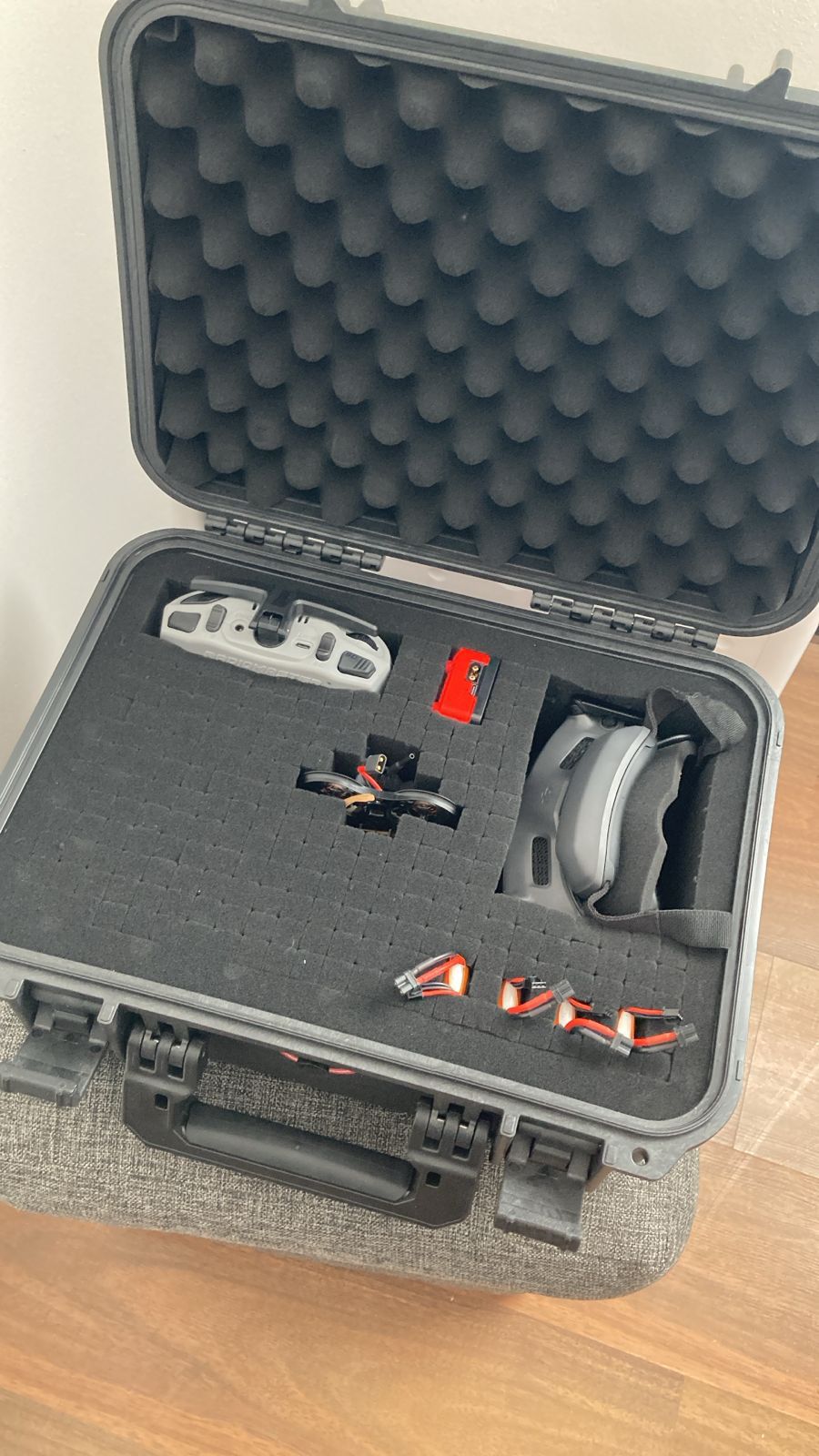
Here’s the way I started thinking about it after a few years of cinematic work and then a serious move into FPV (DJI Avata 2 and a BetaFPV Pavo 2 are my current FPV stack):
The distance between an FPV drone and a traditional drone is roughly the same as the distance between a drone and a regular camera. They share a category on paper. They don’t share a craft.
That’s not a clever framing. It’s the actual structure. A regular camera and a traditional drone are both used to capture an image — but the disciplines of operating them have almost nothing in common. Camera operators don’t naturally translate to drone work. Drone pilots don’t naturally translate to FPV. The skill stack on each side is so deep and so specific that it takes years to internalize even one of them.
Here’s the long version, for any pilot considering the move.
What’s actually different
Six things. Every one of them takes time to adjust.
1. The control model
Traditional GPS-stabilized drones forgive. Let go of the sticks and the drone hovers in place. The flight controller actively fights drift, holds altitude, holds yaw, and refuses to crash itself into things if it can avoid it. This forgiveness is the whole point of why GPS drones are accessible — beginners can learn to fly them without hurting themselves or the gear.
FPV is the opposite. In Acro mode (the default for serious FPV flying), let go of the sticks and the drone falls. There’s no GPS hold. There’s no altitude hold. The flight controller takes your stick inputs and translates them directly to motor outputs, with very little smoothing. Stick discipline is everything. The drone goes precisely where you tell it to and stops doing exactly what you stop telling it to do.
Drones like the DJI Avata 2 in Normal mode bridge this — they include some stabilization assists for new FPV pilots. But even Normal mode is closer to FPV than to a Mavic. The forgiveness is partial, and the moment you push past the flight envelope it’s tuned for, the drone behaves like an FPV drone, not like a Mavic.
2. The perspective
This is the one most people understand intellectually but underestimate emotionally.
Traditional drone flying happens through a screen on a controller. You look down at a small display, you fly the drone in three dimensions, and you watch your shot composing on the screen. Your eyes are outside the drone. Your body stays oriented to the world around you.
FPV puts the screen on your face. You’re inside the drone’s perspective, head locked to the camera, with no peripheral vision of your real-world surroundings. Your body stays in the chair while your eyes fly. The disorientation in the first hours is real. Some pilots get nauseous. Some can’t hold a bearing past thirty seconds. The brain has to learn to fly without the proprioceptive cues it’s used to using.
Once the brain adapts, the goggles become an asset — your spatial awareness is calibrated to the drone’s environment, not yours. But getting there takes hours of simulator and real flight, and the experience of being in goggles is fundamentally different from the experience of looking at a controller screen. They are not the same activity.
3. The flight envelope
A Mavic flies clean horizontal lines, slow descents, smooth orbits, gentle reveals. The flight envelope is wide for cinematic work and the gear is tuned for it.
An FPV drone flies through gaps. Dives vertically. Inverts. Carves arcs through trees at thirty kilometers an hour. Accelerates harder than a Mavic ever could and decelerates harder still. The flight envelope is so different that pilots transitioning from cinematic feel like they’ve started flying a different category of machine. Which they have.
This isn’t a question of “more capable” or “better.” It’s a question of the kind of motion that’s possible. A traditional drone produces a kind of motion that an FPV drone cannot replicate cleanly (slow, glassy, precisely controlled). An FPV drone produces a kind of motion that a traditional drone cannot replicate at all (fast, dynamic, with motion vectors that fly through obstacles).
4. The relationship between flight and footage
On a traditional drone, the camera is on a gimbal. Flight motion and camera motion are partially decoupled — you can fly toward something and still keep the camera steady on a different subject. The gimbal absorbs vibration. The shot composition is partially independent of the flight path.
On most FPV drones, the camera moves with the drone. Flight motion is camera motion. There’s no gimbal stabilization (or, on some cinematic FPV drones, there’s some — but the relationship is tighter than on a Mavic). When you carve an arc, the camera carves an arc. When you flip, the camera flips. The shot is the flight path, and the flight path is the shot.
This changes the entire creative process. On a Mavic, you compose like a cinematographer — frame, hold, release. On FPV, you compose like a steadicam operator running through a scene — the trajectory is the composition. Different mental model. Different planning. Different post-production.
5. The mindset
Traditional GPS pilots think in destinations: “fly to point A, hold position, do the shot, then fly to point B.” The flight is a series of stops with smooth transitions.
FPV pilots think in trajectories: the path matters as much as the endpoints. You’re choreographing motion through a space, not choreographing positions. The stops, when they exist, are momentary. The shape of the line through the air is the work.
This mental shift is harder to make than the mechanical one. Pilots who can intellectually understand FPV controls but who keep thinking in cinematic-drone destinations end up flying FPV badly — choppy, indecisive, technically capable but creatively clumsy. The fluency comes when the mindset shifts.
6. The failure modes
When a Mavic loses signal or has a problem, it hovers in place and waits for you. It activates Return-to-Home. It descends gently. It tries hard not to crash itself. The failure modes of GPS drones are mostly soft.
When an FPV drone has a problem, it usually drops. There is no GPS to fall back to. There is no altitude hold. The motors stop, the airframe falls, and where it lands is where it lands. The failure modes are hard, fast, and unforgiving.
This is why FPV pilots crash much more often than cinematic pilots, even after experience. It’s not skill deficit; it’s the structural reality of the gear. Working FPV pilots replace airframes regularly — sometimes every few months in heavy use. The 20-flight amortization framework I wrote about in this piece is even more important in FPV than in traditional flying. Plan for the gear loss.
Why filmmakers think FPV is “next level” (and why they’re wrong)
The marketing around FPV — particularly around the DJI Avata line, which has done more to popularize FPV than anything else — pitches it as the next step for cinematic pilots. “You’ve mastered the basics, now elevate your shots.”
That framing is appealing because it’s continuous. “Just one more skill to learn.” But it’s not how the actual transition works.
A pilot with two thousand hours of cinematic GPS flying does not have two thousand hours of FPV-applicable skill. They have, perhaps, fifty applicable hours — basic spatial awareness, an understanding of weather and conditions, a sense of how to read a flight envelope. The other 1,950 hours of muscle memory don’t transfer. Some of it actively interferes (the instinct to release the sticks for hover, which causes an FPV drone to fall).
Most pilots who buy FPV gear thinking it’s the next step quit after the first few weeks. The simulator is harder than they expected. The first real flights are nerve-wracking. The crashes happen. The footage they imagined doesn’t come out the way they imagined. They put the FPV gear in a closet and go back to their Mavic.
This isn’t failure. It’s an accurate response to discovering that the activity is different from what was advertised. The pilots who do make the transition are the ones who treat it as starting over, not as an upgrade.
The real use cases for FPV in working pilot life
Not every commercial pilot needs FPV. Most don’t. Here are the cases where it actually pays to invest the months of learning.
Cinewhoop interior tours. The smooth one-shot fly-through of a property — house, restaurant, hotel — that simply isn’t possible with any other tool. For premium real estate work and hospitality marketing, this is the use case where FPV genuinely creates value that nothing else can.
Music videos and commercials. The dynamic, motion-rich shots that have become a signature of FPV — flying through a band on stage, around a moving subject, through environments that traditional drones can’t enter. This is where most full-time FPV cinematographers earn their living.
Action sports and extreme sports. Skiing, mountain biking, surfing, parkour. The relative-motion problem that makes traditional drones limited (the subject moves and you can’t keep up) is exactly what FPV solves.
Inspection co-review. As I covered in my piece on drone inspection, FPV goggles can be extended to a client-facing screen, allowing a real-time co-review of the inspection that traditional drone work can’t match.
Specific cinematic establishing shots. Sometimes the shot just demands FPV motion. A reveal that needs to fly through a frame, around an obstacle, into a courtyard. These shots exist in working filmmaker briefs occasionally, and a working pilot who can deliver them is worth more than one who can’t.
If your work doesn’t include any of the above on a regular basis, FPV is a creative interest, not a business investment. That’s fine — but it’s worth being honest about which it is.
When NOT to learn FPV
Most working pilots, in honesty.
- If your bookings are mostly weddings and standard real estate, FPV won’t pay back the time investment. The clients aren’t asking for it and the gear is harder to fly safely at events.
- If you’re a beginner with under a year of paid flight time, learning FPV will cost you more than it returns. Get good at one thing first.
- If you don’t have time for 50–200 simulator hours over your first six months of FPV ownership, you’re going to crash gear faster than you’ll learn from it.
- If you fly mostly in difficult-weather conditions, FPV will frustrate you — every FPV airframe is significantly less wind-tolerant than a comparable Mavic.
When to invest the time
Specific, intentional cases:
- You have a defined creative niche that demands FPV motion (music videos, action sports, premium real estate FPV interiors)
- You have an existing client who has explicitly asked for FPV deliverables and is willing to pay during your learning period for less-than-perfect output
- You’re committed to spending at least 50 simulator hours and 50 real-flight hours in your first year before the work shows up
- Your business has the slack to absorb gear losses during the learning curve
If you can’t say yes to most of those, wait. The right time to learn FPV is when the demand for it shows up in your work, not before.
My own transition
I picked up the DJI Avata 2 a couple of years back, after the bulk of my cinematic and government work was already established. The transition wasn’t because I was bored with traditional flying — it was because I’d been turning down jobs that needed FPV-style motion and watching those briefs go to other pilots.
The first three months were humbling. I’d been flying GPS drones for years at that point. I considered myself a competent pilot. I crashed the Avata multiple times in the first month, learning that “competent pilot” was a description specific to the gear I was trained on. The simulator hours felt unproductive. The first real flights felt nerve-wracking in a way I hadn’t experienced since 2018, when I bought my first Phantom and didn’t know what I was doing.
By month four, the motion started to feel natural. By month six, I could deliver paying work in cinewhoop interior style and basic cinematic FPV reveals. By month nine, I’d added a Pavo 2 for the work that demanded sharper control of the flight envelope.
I’m still not what I’d call a fluent FPV cinematographer. The pilots who fly FPV full-time at the high end have hours of muscle memory I don’t. But I’m fluent enough to take the work that needs to be done in this style, and to refuse the work that’s better done with a Mavic and a gimbal.
The lesson I’d offer to any pilot considering the move: it’s worth doing if you’re committed to a defined creative or commercial reason. It’s not worth doing as a generic “level-up” because everyone on YouTube is talking about FPV. The gap is too wide to cross casually. Either the work is pulling you across, or you stay where you are. Both are honorable choices.
Just don’t pretend you’ve crossed when you haven’t. The footage shows it.