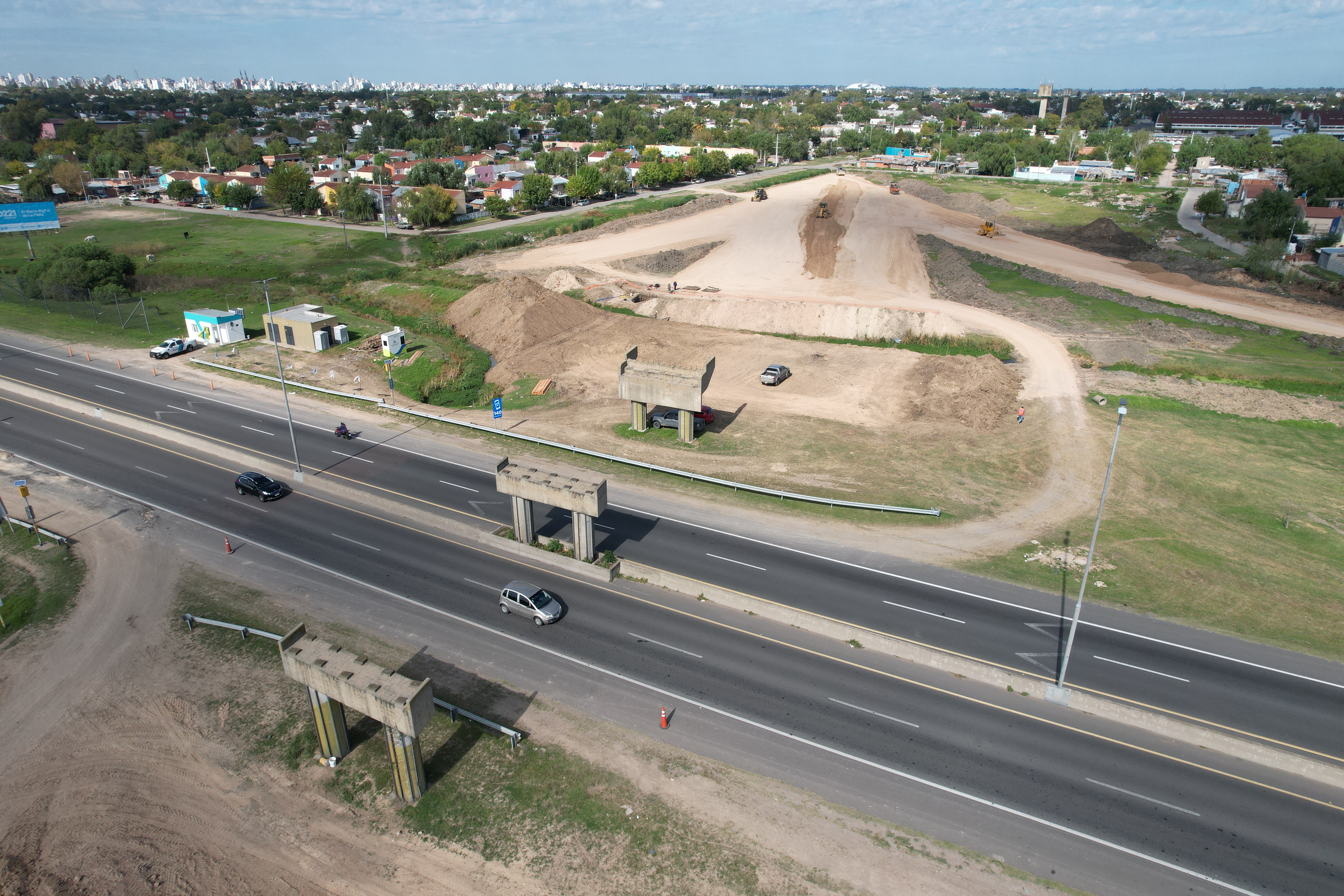
If you Google “drone bridge inspection,” you’ll find a long list of articles selling drones as the perfect tool for the job. Fast, safe, cost-effective, no scaffolding, no traffic closures. Most of those articles are written by drone manufacturers, by consultants who never flew a paying inspection, or by content shops trying to rank for a keyword.
I covered bridges for four years as the official filmmaker for the Governor of Buenos Aires Province, flying over public infrastructure across one of the largest provinces in Argentina. I flew over highway bridges, pedestrian crossings, channel dredging, and the kind of mid-construction overpasses that look like they’re built out of skeletal steel. I know what a drone actually delivers on bridge work, and I know the hard limitation that almost nobody puts in the marketing copy.
Here’s the version that’s true.
The gimbal looks down. That’s the entire problem.
A standard drone — Mavic, Mini, Avata, even most enterprise units — has a gimbal that can tilt the camera from horizontal (pointing forward) down to vertical (pointing straight down at the ground). What it cannot do, in any meaningful way, is tilt up.
You cannot fly a drone under a bridge and aim the camera ninety degrees up at the underside. You cannot fly off the side of an overpass and tilt the lens forty-five degrees up at the girders. The hardware physically does not move that way. Some specialized inspection drones (Flyability Elios, certain Skydio configurations, custom-built inverted-gimbal rigs) can. They cost in the tens of thousands and require trained operators. A standard working pilot’s kit cannot.
Drones see the top of a bridge in detail. They see the sides, with some maneuvering. They effectively cannot see the underside, which is exactly where most structural problems hide.
This single physical constraint reshapes the entire conversation about what drone work for bridge inspection actually is.
What drones do well on a bridge
Within the gimbal’s range of motion, drones genuinely outperform every alternative. Several use cases where a drone delivers value that scaffolding, lift trucks, or human inspection cannot match.
Top-deck condition surveys. Pavement cracking, expansion joint wear, surface drainage problems, vegetation growth in joints, ice/salt damage on the deck — all visible from above at altitude. A drone can map the entire deck in 15 minutes with overlapping passes and produce a high-resolution composite the inspector reviews on a monitor afterward. Faster than walking it. Safer than blocking traffic.
Approach geometry and clearance. Drone footage from a known altitude with GPS metadata gives you measurable angles of approach, distances between bridge and surrounding infrastructure, overhead clearance from above the deck. Useful for pre-construction surveys and post-construction documentation.
Exterior side views. Concrete spalling on the visible side of beams, water staining patterns indicating drainage issues, rebar exposure on accessible faces, paint condition on steel members. Anything the gimbal can reach within its angular range, the drone captures cleanly.
Surrounding-environment context. Erosion patterns around abutments, debris accumulation at pier bases, scour evidence in the riverbed near supports — all visible from oblique angles the drone handles well.
Post-event damage assessment. After flooding, an earthquake, a vehicle strike, a fire — the drone can document the visible damage state of a bridge in hours instead of the days it would take to mobilize traditional inspection equipment. Time is the win here.
For all of the above, the drone is genuinely the right tool. Not “the future” — the right tool today, used by working pilots who know how to fly infrastructure environments.
What drones cannot do on a bridge
This is the part missing from most articles selling drone inspection services.
Inspection of the underside of the deck. The bottom of the bridge — the soffit, the beams seen from below, the deck slab from underneath — is invisible to a standard gimbal. You can fly under the bridge with the drone. You cannot point the camera upward to see what’s there. You see the river, or the road below, or the void; you do not see the structure overhead.
Expansion joint condition from below. Joints leak. Water stains the beams and bearings beneath them. From above the joint, you see the surface. From below, you see the symptoms — which is where the diagnosis usually lives. Drones do not see this view.
Bearing inspection. The bearings that connect the bridge superstructure to the piers — elastomeric pads, pot bearings, rocker arrangements — sit beneath the deck on top of the piers. They corrode, they shift, they tear. They are inspected from below or from inspection platforms. A drone cannot see them.
Crack propagation in girders. The longitudinal cracks in main support beams are most visible from underneath. The drone sees the side face of the girder if it can position itself there, but not the underside.
Pier integrity in water. Many bridges have piers founded in rivers, canals, or estuaries. The portion underwater is inspected by divers, not drones. The portion at the waterline is splash-damaged and most clearly seen from a boat or rope access. Drones contribute peripherally here, not centrally.
So when a client says “I need a bridge inspection by drone,” the honest answer is: “I can give you complete coverage of the upper surfaces and contextual coverage of the surroundings. For the structural underside, you still need traditional inspection methods. Here is what each costs and which combination makes sense for your situation.”
That conversation, repeated honestly, is how working pilots build long-term relationships with infrastructure clients. The pilots who promise total bridge inspection from a drone get hired once.
When to take the contract — and when to walk
After working enough infrastructure jobs, I developed a rough decision rule for bridge work.
Take the job when:
- The client understands a drone is part of an inspection plan, not the entire plan
- The deliverable is documentation of deck condition, surroundings, or post-event damage — not full structural assessment
- The bridge is over land or shallow water (lower-risk launch and recovery)
- There is room to land safely in case of GPS or weather issues
- The client is willing to pay for proper coverage time, not a rushed pass
Walk away when:
- The client expects the drone to replace structural engineering inspection of the underside
- The bridge spans deep water with no safe contingency landing
- Air traffic regulations near the bridge require waivers the client wants you to handle for free
- The job is sold as “quick” — bridges in real conditions are rarely quick
- The contract assumes a deliverable that the gimbal cannot physically produce
The walk-away rule matters most. Pilots who say yes to impossible bridge contracts deliver footage their clients won’t accept, then get blamed for the gap. Pilots who clarify the gimbal limitation upfront, in writing, get hired again.
Pricing the work
Bridge inspection is not standard real estate aerial work and should not be priced as such. The risk profile is higher (overhead obstacles, traffic below, often near restricted airspace), the deliverable requires more flight time, and the client base is professional infrastructure management with serious budgets.
I’ve written elsewhere about how I structure commercial real estate pricing in The Real Estate Drone Pricing Trap — most of the same principles apply but the multiplier is different. Three things to incorporate into a bridge inspection quote:
-
Site survey before quoting. Never quote a bridge inspection without seeing the location. Wind patterns near bridges are unpredictable. Cable interference is common. The launch zone you assumed exists may not.
-
Risk premium. Flying over water, near traffic, around live infrastructure — these are not standard commercial conditions. Build in a 30–50% premium over your real estate baseline for bridge work.
-
Re-shoot contingency. Weather affects bridge work more than ground-level commercial shoots. Quote one site visit; bill a fixed re-shoot fee if the first pass is wind-cancelled. Most reasonable clients accept this readily.
The full pricing structure depends on your local market, but the principle holds: bridge work earns more per hour than real estate, deserves more pre-flight planning, and should carry contractual language about scope and re-shoots.
The risk profile, briefly
Bridge environments are some of the most operationally demanding I’ve flown in. A short list of what catches working pilots out:
- Cable interference around bridges — many overpasses run high-tension lines parallel or perpendicular. Proximity sensors don’t always catch thin cables. I wrote about the wall effect in my piece on the three drones I crashed; similar dynamics happen near bridge structures.
- GPS multipath errors under large steel structures — your position estimate drifts in ways that don’t show clearly in the controller until something goes wrong.
- Traffic-induced air movement — passing trucks create turbulence that translates upward more than people expect. Position the drone with margin from the traffic plane.
- Wind funneling through bridge spans — wind direction at deck level is often different from wind direction off the deck, sometimes opposite. Test before committing to a flight path.
None of this is reason to avoid bridge work. It is reason to budget time for proper site survey and to refuse contracts where the budget assumes a quick pass.
The honest answer to “can a drone do my bridge inspection?”
Most of it, yes. Not all of it.
If you understand which parts a drone covers cleanly (deck, sides, approach, surroundings) and which parts still require traditional methods (underside, bearings, underwater piers), the drone earns its place in your inspection workflow and saves you real money on the upper portion of the job.
If you assumed the drone replaces inspection entirely, the contract you’re about to sign will disappoint you, and the working pilot who quoted that promise will lose your repeat business after the first project.
The gimbal looks down. That’s the limit. Everything else worth knowing about drone bridge inspection follows from that single physical fact, and from the pricing and contract discipline that an honest working pilot brings to the work.